
Advertisement feature — this page is published by Scentech.
Essential oil diffuser vs pod diffuser: what changes at home
Almost every electric diffuser sold in the UK belongs to one of two families, and the box rarely tells you which one you are holding. The first is an essential oil diffuser in the ordinary sense: a small tank of water, a few drops of whatever oil you already own, a visible cool mist. The second is a pod machine: a sealed bottle of blended fragrance oil, no water at all, and a rule about what you may put in it. They sit on the same shelf at broadly similar money and they are not similar to live with.
This page is the long version of a paragraph in our comparison of seven oil diffusers. Nothing here rests on a test of ours; every line below is a published specification, a dated price, or plain arithmetic with the assumption shown.
What goes into an essential oil diffuser
Under the water sits a ceramic disc vibrating at a frequency you cannot hear. It throws the surface of the water into a fine cool fog and a small fan pushes it out of the top; any oil floating on the water goes out with it. That is the whole mechanism, and it explains nearly everything that follows — it is inexpensive to build, it is gentle on the oil, and it puts moisture into the room whether or not moisture was the plan.
The word doing the work is water. John Lewis's own instructions for its Electric Diffuser are to fill the tank with 100 ml of clean water and add two to three drops of essential oil, which is the ratio you are actually breathing: overwhelmingly water, faintly oil. Tanks on the models in our ranking run from 100 ml (John Lewis, Tisserand) to 180 ml (Beurer LA 40). Stated run times run from "up to 45 minutes" in John Lewis's specification table, through Tisserand's four to five hours of continuous mist, to Beurer's one, three or seven-hour timer.
The freedom is real. Lavender this week, sweet orange the next. Holland & Barrett prices Miaroma lavender at £15.00 for 30 ml, or £0.50 a millilitre, and at two or three drops per fill a bottle that size lasts a long time.
The limit is also real, and it is narrower than the reputation suggests. Beurer asks specifically for water-soluble aroma oil in the LA 40, not for any oil in the cupboard. Read the refill rule on the page before you assume a water tank means anything goes.
What goes into a pod diffuser
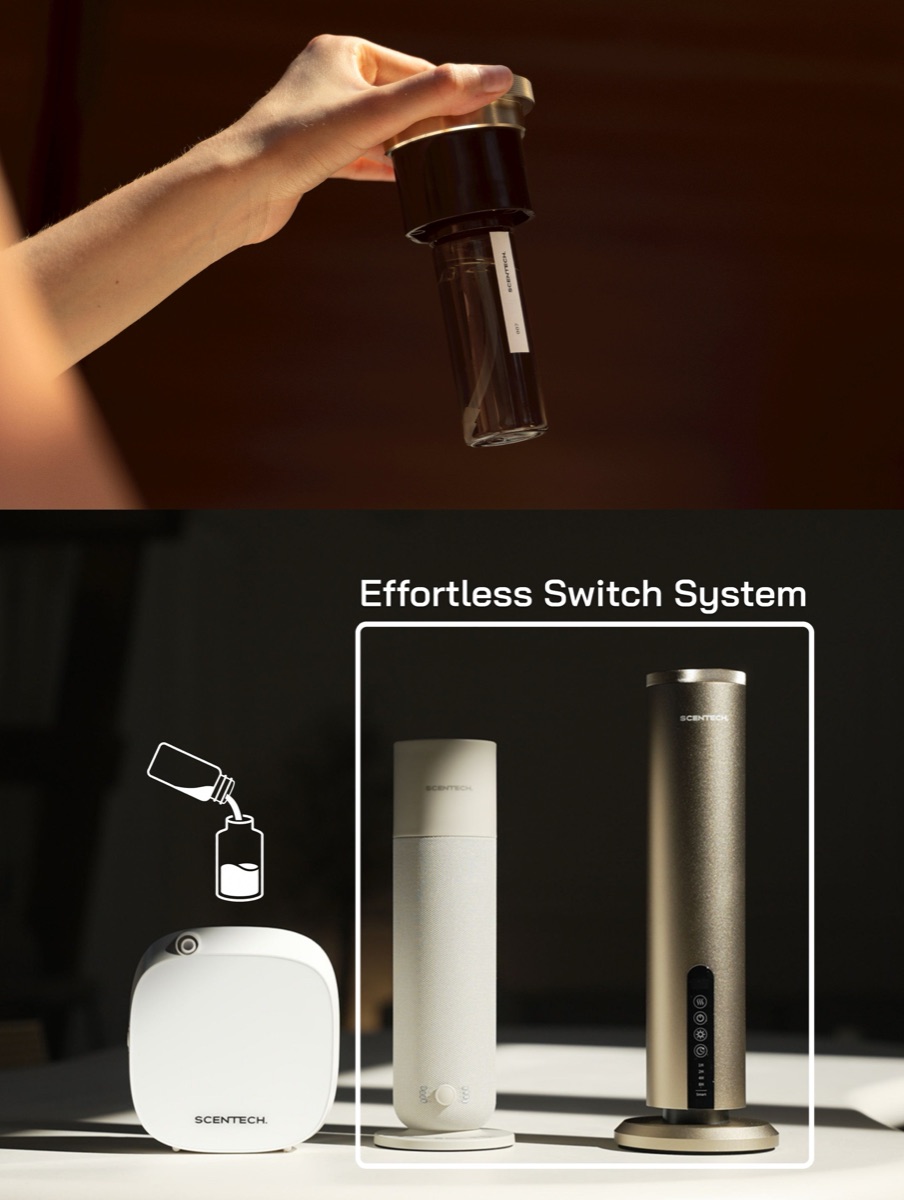
A pod machine takes the oil neat and shears it into a dry mist with air pressure alone — Scentech calls its version cold-air diffusion. There is no water to dilute it and no heat to alter it, so nothing condenses on the windowsill because nothing wet leaves the machine.
What goes in is a sealed 65 ml bottle of blended fragrance oil, and this is the part worth being blunt about: it is not a pure essential oil and Scentech does not sell it as one. It is a composition, built to hold its shape in moving air. The company states its oils are IFRA-compliant and lists the notes for each scent.
What also goes in is nothing else. The manufacturer's English FAQ is short about it — "Never use water or oils meant for a water-based diffuser" — and other oils fall outside the one-year warranty. A pod diffuser is a closed system in the way a coffee machine that only takes its own capsules is a closed system, with the same advantages and the same irritation.
The consequence of neat oil is concentration. Scentech's three models state coverage of up to 40, 65 and 100 m²; the only water-tank model in our ranking that states a room size at all is the Beurer LA 40, at up to 20 m². Those figures come from different companies using no shared method, so treat them as claims rather than measurements — but the gap between 20 and 65 is not a rounding error.
Six differences you notice at home
1. What you are allowed to put in it
This is the first question and most people ask it last. An essential oil diffuser will take the bottle you already own, which is why it is the right machine for anyone who enjoys choosing oils. A pod machine will not, ever, and enjoys nothing about it. If half the pleasure is a single distilled note picked off a shelf on a Saturday, the closed system will annoy you every time you look at it.
2. How often you refill, and with what
An essential oil diffuser is refilled by the fill. Tisserand states four to five hours of mist per 100 ml, so roughly an evening. John Lewis states 45 minutes for both of its own models. Either way it is a jug of water carried through from the kitchen whenever you want the room to smell of something.
A pod machine is refilled by the pod. Scentech states one to three months per 65 ml ScentPod depending on hours and setting, with a worked example of twelve hours a day on a medium setting lasting well over two months. The Diffuser 2 and the Pro take a pod that clicks into place; the smaller Smart Aroma Diffuser has to be decanted into a reservoir, which is one of the two genuine drawbacks we list against it.
3. Dilution, and how far the scent travels
Two or three drops in 100 ml of water is a dilute thing to send into a room, which is why water-tank models are honest small-room devices even when their pages decline to say so. Neat oil in moving air is not dilute, which is where the 40, 65 and 100 m² claims come from. Stated coverage is the first number to look for, and its absence is itself an answer.
4. Water: cleaning, limescale and damp
Any tank of standing water in a warm room becomes a housekeeping job. The US Environmental Protection Agency, writing about home humidifiers, advises emptying and drying the tank daily, because ultrasonic and impeller devices can throw micro-organisms and dissolved minerals from the water into the air. An ultrasonic diffuser works on the same principle, so the same advice applies. In a hard-water part of the country you will be descaling it as well.
A pod machine has no tank, so there is nothing to empty, nothing to dry and no limescale — and it adds no moisture to the room. Between October and March that is a genuine difference in a flat that already shows condensation on the bedroom window in the morning.
5. Noise
Scentech publishes 59.5 dB for the Smart Aroma Diffuser and 39.5 dB for the Diffuser 2 and the Pro. Not one of the five water-tank models in our ranking publishes a decibel figure — not John Lewis, not Beurer, not Tisserand, not Stoneglow, not HoMedics. None of that proves they are loud. It is evidence that you cannot find out until it is beside the bed.
6. What a millilitre costs, and why that number is a trap
On the face of it the pod wins: £27.00 for 65 ml is £0.42 a millilitre, against £0.50 for Miaroma lavender at 30 ml, £0.56 for Dr Organic at 10 ml, £0.98 for Tisserand organic at 20 ml and £1.28 for the same oil in a 9 ml bottle. Stoneglow's own 15 ml diffuser oil at John Lewis is £0.73.
Stopping there would mislead, so we will not. The millilitres are not doing the same work: an ultrasonic machine uses two or three drops per fill, so a 30 ml bottle lasts months, while a pod machine consumes neat oil continuously, which is why 65 ml is gone in one to three months. No maker of a water-tank diffuser publishes consumption per hour, so its monthly oil cost cannot be calculated at all — and nor can ours be set against it. The running-costs page shows the arithmetic and marks where it stops.
Where the essential oil diffuser genuinely wins
Three things, all real. It is cheaper to buy: £39.99 to £55.00 for the water-tank models in our ranking, against about £101 to £193 for the Scentech range at September 2026 conversion rates. It takes any suitable oil you like, which matters if you already own a shelf of them or want a single note rather than a composition. And in a small room it is entirely sufficient — a bedroom or a home office sits comfortably inside the 20 m² the Beurer commits to.
One machine fits neither box cleanly: the Stoneglow Modern Classics Perfume Mist Electric Diffuser takes a 15 ml bottle that John Lewis states lasts up to ten weeks, but the retailer never says whether water is involved, so we do not claim it is either. A page that will not name the mechanism is worth noticing before you spend £65.
Which to buy
Buy the essential oil diffuser if you own oils, like choosing them, are scenting one room and do not mind the water. Look for a stated room size before anything else, and treat a missing decibel figure as a risk beside a bed.
Buy the pod machine if the job is a floor rather than a room, if it has to run for hours without becoming a chore, or if extra winter moisture is the last thing the house needs — and if you can live with a closed system, because that is what you are signing up to.
Our seven-model ranking works through the specific machines in each camp, with prices and review counts as they stood on 9 September 2026: see our pick and the full comparison.